What if your reservoir could do more than store water?
 Author: Genap
"Every greenhouse already owns an energy source. The challenge is no longer finding energy, but learning how to unlock the energy stored in water."
Francisco Modaca Duarte (Wageningen University & Research)
If someone had suggested ten years ago that a water reservoir might become one of the most valuable energy assets on a greenhouse site, the idea would probably have been dismissed. Reservoirs existed for one purpose: storing irrigation water.
Today, that conversation sounds very different.
During GreenTech Amsterdam 2026, Genap brought together specialists in water storage, energy systems, floating solar and horticultural research to explore how water is taking on an entirely new role inside the modern greenhouse. Rather than introducing another new technology, the discussion challenged the way growers look at an asset they already own.
Perhaps the real question is no longer how to produce more energy. It's how to make better use of the energy that's already there."
Water has always stored energy, we just never looked at it that way.
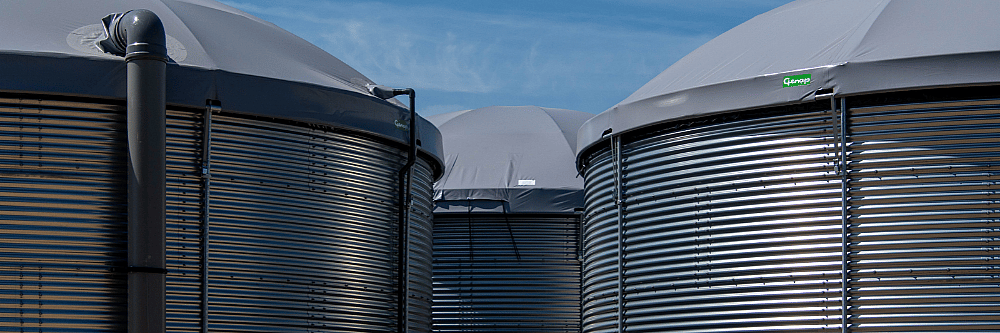
Every reservoir acts as a giant thermal mass. Because water changes temperature far more slowly than air, it provides a stable source of thermal energy that can be recovered by water-source heat pumps more efficiently than many growers realise.
According to Tom de Vos (Sprinkler Energy), this shift in perspective is where the real opportunity begins. Once water is no longer viewed purely as irrigation storage, an entirely new range of possibilities opens up. A reservoir stops being just a buffer for water and starts becoming a buffer for energy.
The breakthrough isn't a new technology
One misconception surfaced repeatedly during the discussion. Many assume the next breakthrough will come from a revolutionary invention. The panel largely disagreed.
Floating solar, water-source heat pumps, thermal storage, battery systems and smart energy management already exist. What's changing is the way these technologies work together.
Electricity generated by floating solar can power a heat pump. Thermal energy can be stored in the reservoir and used when demand increases. Batteries help balance electricity demand, while CHP installations continue to provide flexibility where needed. Software coordinates the entire system, deciding which energy source delivers the best result at any given moment.
As Richard Nieuwenhuizen (Aquasol Solar) pointed out, future greenhouses will not depend on a single energy source, but on the ability to switch intelligently between many. The innovation, therefore, isn't the equipment itself—it's the orchestration.
That integrated approach has become even more relevant as grid congestion limits the ability of growers to expand their electricity connections. Energy that can be generated, stored or recovered on site is becoming increasingly valuable. Water storage fits naturally into that equation because it allows thermal energy to be shifted through time, adding flexibility to the entire energy system.
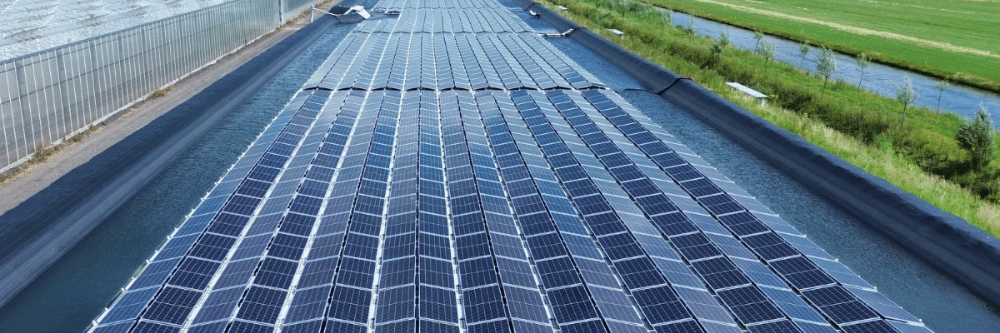
The same principle applies to floating solar. Reservoirs already occupy valuable space within greenhouse operations, making them an ideal location for renewable electricity generation without sacrificing productive growing area. At the same time, the panels reduce evaporation, limit algae growth and contribute to more stable water temperatures. Infrastructure is no longer expected to perform just one task. Increasingly, every asset is expected to fulfil multiple functions.
More than a reservoir
One message remained remarkably consistent throughout the seminar: there is no universal blueprint. A reservoir in Spain behaves differently from one in Canada, just as a tomato grower faces different challenges than a strawberry producer. Climate, crop strategy, reservoir size, water temperature and local energy prices all influence the best solution.
According to Chrétien Hendriks (Genap), Infrastructure is no longer expected to perform just one task. Increasingly, every asset is expected to fulfil multiple functions. Water storage fits naturally into that equation because it allows thermal energy to be shifted through time, adding flexibility to the entire energy system.
Perhaps the seminar's most valuable conclusion, however, had little to do with technology.
For decades, irrigation, climate control and energy management have evolved as separate disciplines. That distinction is rapidly disappearing. Water influences crop performance, renewable electricity powers heating and cooling systems, while digital controls determine when energy should be stored, recovered or exchanged. Together, these technologies form a single ecosystem in which water becomes the connecting element between irrigation and energy management.
That may ultimately be the seminar's most important takeaway. The greenhouse of tomorrow won't simply use water to grow crops. It will use water to manage energy more intelligently, transforming one of its oldest assets into one of its most valuable.


Have exclusive horticulture technology news delivered to your inbox
The GreenTech monthly newsletter brings you the latest exclusive horticulture technology news and updates about our global horticulture technology trade shows and events.
Join over 34,000 of your peers and receive:
☑ In-depth articles about greenhouse developments
☑ Exclusive commentary from industry leaders
☑ Knowledge session recordings and other event updates