Reducing CO2 across the entire supply chain
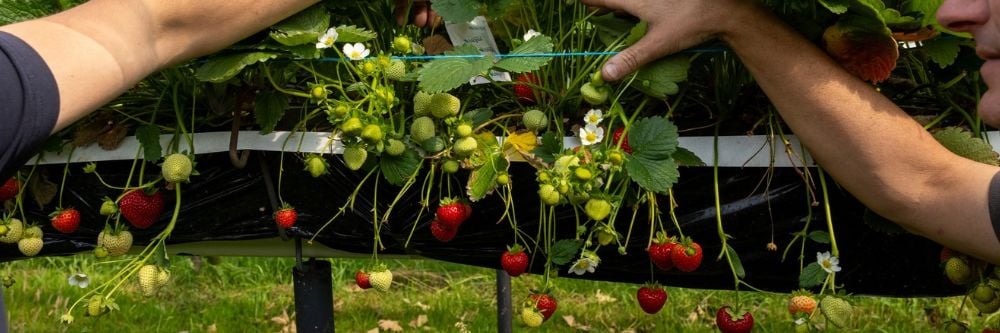
A unique chain project in the Netherlands: Strawberry grower Verkuijlen, cultivation specialist Van Iperen, fruit and vegetable supplier Bakker Barendrecht, and retailer Albert Heijn (part of Ahold) have joined forces to reduce CO2 emissions. To achieve this, they are utilizing a circular fertilizer. According to the parties involved, collaboration is essential for driving breakthroughs
The extensive supply chain collaboration involving growers, suppliers, wholesalers, and retailers is remarkable. It stems from Albert Heijn’s ambition to reduce greenhouse gas emissions across its supply chain by 45 percent by 2030, compared to 2018 levels. To achieve this, all of the retailer’s strategic partners, including Bakker Barendrecht, have been asked to identify the sources of these emissions and explore potential solutions. According to Bakker Barendrecht, 50 percent of the CO2 emissions originate from greenhouse horticulture, driven by natural gas consumption. Another 8-10 percent comes from fertilizers, with 80 percent attributed to synthetic nitrogen.
In the search for initiatives to achieve CO2 reduction throughout the supply chain, several pilot projects were launched. One of these focuses on reducing the use of synthetic fertilizers, with Bakker Barendrecht taking the lead. “We have developed a number of strategies for this, including replacing synthetic fertilizers with natural alternatives. Examples include fertilizers derived from animal manure, compost, and green manures. In our effort to make greater use of natural nitrogen available within the Netherlands, we turned to Van Iperen and their ‘GreenSwitch’ solution.”
All supply chain partners
Strawberry grower Verkuijlen has been supplying strawberries to Bakker Barendrecht for 45 years and is also a client of Van Iperen. The company’s strawberries have been on the shelves at Albert Heijn since as far back as the 1980s. “Through Van Iperen, we asked Verkuijlen if they would like to participate in the strawberry pilot,” Van Iperen explains. “What’s great about this project is that all parties in the supply chain are directly involved. It’s a perfect example of a circular approach: the livestock sector has a nitrogen surplus, while the horticultural sector has a high demand for nitrogen.”
GreenSwitch is a liquid, green fertilizer produced in a virtually CO2-neutral manner. It is manufactured at a biogas plant in the Netherlands. To produce GreenSwitch potassium nitrate, ammonium is extracted from liquid digestate; aerobic bacteria then convert this ammonium into a nitrate fertilizer, in this case, potassium nitrate. Once the bacteria have produced the nitrate fertilizer, it is purified and concentrated through a series of membrane-based processes. GreenSwitch potassium nitrate is of such high purity that it can serve as a direct, one-to-one replacement for conventional crystalline potassium nitrate. The liquid digestate is a residual stream left over from the production of green gas. The process yields 1,300 cubic meters of gas per hour, 300 cubic meters of which are used for on-site power generation via a combined heat and power (CHP) unit. The remaining 1,000 cubic meters of green gas per hour are fed into the grid.
Rigorous testing first
For Bakker Barendrecht, the key question is whether it is possible to reduce CO2 emissions throughout the entire supply chain while maintaining product quality. How does this work in practice? "The fertilizer is applied to the crops via the irrigation water. You want a product to be thoroughly tested before you can roll it out on a large scale. Furthermore, this liquid fertilizer requires five to six times the volume of conventional synthetic fertilizer and is approximately twice as expensive. What are the cultivation costs, and what is the yield? We want to gain a clear picture of this through the pilot project," explains the fruit and vegetable supplier. During the project, the difference in cost is being covered by Albert Heijn.
Van Iperen expects that the production of this circular fertilizer will become even more efficient over time, leading to further reduction in its price. Conventional synthetic fertilizers, by contrast, are likely to become more expensive due to rising taxes on gas consumption and the potential future inclusion of CO2 emission costs in the final product price. “Ultimately, the prices of both products will converge. Furthermore, CO2 is increasingly acquiring an economic value; in the near future, every ton of CO2 that is not emitted will translate into a financial benefit.”
Sustainability as a starting point
For grower Mark Verkuijlen, the GreenSwitch pilot was a logical step. “It is unique to have four parties collaborating to reduce CO2 emissions. If we have the opportunity to become more sustainable, we should certainly pursue it. That is our primary motivation for participating in this project.” The circular fertilizer is applied to the strawberries via the irrigation lines. “This requires us to adjust our nutrient regimen, which we are doing in collaboration with a fertilization specialist from Van Iperen,” he explains.
If the new fertilizer proves successful, Verkuijlen is continuing to use it. “By then, the production process for this liquid fertilizer might have advanced to the point where it costs the same as conventional synthetic fertilizer,” he says with a laugh. Like Van Iperen, the grower believes that, in time, a price tag will be attached to CO2 emissions. “That isn’t the case yet, but it is bound to happen in the future. You have to factor those costs into your calculations.”
Working together
Supermarket chain Albert Heijn believes that collaboration with and among supply chain partners is essential for achieving greater sustainability in the fruit and vegetable sector. “The supply chain belongs to all of us, and we often face the same challenges. If we don’t work together to explore potential solutions, we miss out on a level of efficiency that is crucial. Given the urgency of the issue, speed is essential. Albert Heijn is well-positioned to identify relevant stakeholders within our supply chains, take the initiative to connect them, and provide the necessary support.”
Furthermore, the retailer considers it important that the greenhouse horticulture sector continues its sustainability journey. “This sector plays a vital role in providing consumers with healthy and nutritious food. At Albert Heijn, we believe in the power of our partner network to scale up and advance sustainable initiatives. Open and transparent communication is key, as is the sharing of knowledge, experiences, and challenges. Collaboration across the entire supply chain is necessary to achieve sustainable breakthroughs.”
Have exclusive horticulture technology news delivered to your inbox
The GreenTech monthly newsletter brings you the latest exclusive horticulture technology news and updates about our global horticulture technology trade shows and events.
Join over 34,000 of your peers and receive:
☑ In-depth articles about greenhouse developments
☑ Exclusive commentary from industry leaders
☑ Knowledge session recordings and other event updates