Clean data is the new plant health
 Spire Group
Every grower runs a protocol. You quarantine new plant material, you put a footbath at the door, and you walk scouting rounds on schedule. You also record every batch, so that when something appears, you can trace its origin. Nobody here debates whether hygiene earns its keep, because we have all seen what one careless introduction costs.
Yet nobody puts a footbath at the door of the ERP. There, a number can leave a spreadsheet nobody owns, land in a report, and by Thursday it can carry a promise to a retail customer. No quarantine. No screening. No record of where it came from.
We disagree about definitions, not data
Take a Monday in week 14. A customer asks you to pull a promotion forward, so Sales checks availability. Planning then quotes a different number, while Logistics knows Quality rejected two trolleys yesterday. Four people spend an hour on the phone.
Blame the systems and you will miss the point. “Available” means four things in four places: what stands on the floor, minus what you reserved, minus what carries quality risk, minus what you promised a customer. So, every department is right within its own logic. Four defensible answers to one question are therefore not a technical failure. It’s a decision nobody ever made.
AI will not fix this. It will industrialize it.
Put an AI assistant on top of four definitions and it will not pick the right one. Instead, it picks one, states it with confidence, and repeats it a thousand times before anyone notices. No wonder that 88% of organizations now use AI, yet only 39% see measurable impact. The model is rarely the obstacle.
And agents raise the stakes, because soon they will consult each other: a service agent asking a logistics agent before it answers your customer. An agent working from a contested number then does more than answer wrongly. It hands that answer to the next agent as an established fact.
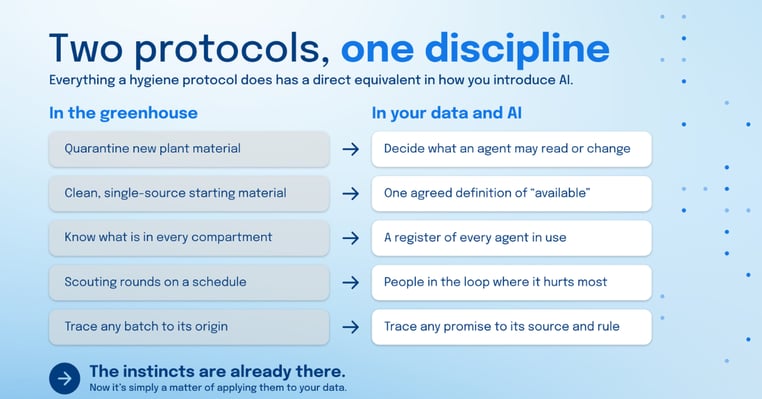
Every step in a hygiene protocol has a direct equivalent in how you introduce AI.
You already know how to do this
Fortunately, horticulture does not need a new philosophy. It simply needs to apply a trusted one.
- Start clean. Agree on what “available” means, define it once, and serve it from one place. After all, you cannot correct infected material downstream, and a contested definition behaves the same way.
- Quarantine before you introduce. Decide what each agent may read and what it may change. Reading availability is not the same as committing stock, so that rule belongs in the layer connecting your systems, not in an agent’s instructions.
- Know what’s in the house. Keep a register of every agent running, what it reaches, and who owns it.
- Walk your rounds. Whatever behaves at launch will drift, so keep a human in the loop where it hurts: pricing, allocation, credit, quality claims. Autonomy is a dial, not a switch.
- Give decisions a passport. You already trace a batch to its origin, so trace a delivery promise the same way: which agent, which source, which rule.
Hygiene has never slowed anyone down
After all, no grower treats quarantine as a brake on production. On the contrary, it lets you work at scale without one incident taking out the season. The same holds here: sort this out first, and you can let AI near a customer promise without flinching.
So, ask yourself: which decisions do we make on numbers we do not fully trust? And who would notice tomorrow if an agent quietly got it wrong?
That is the work we do at Spire: helping growers and traders agree on what their data means and putting governance around AI before it reaches a customer promise. We opened this conversation at our GreenTech session, and what we heard there shaped much of what you just read.
Continue the conversation: hello@spire-group.eu | www.spire-group.eu
Sources: McKinsey, The State of AI; MuleSoft, "Closing the Value Gap with an Agentic Enterprise" (2025).

.jpg?h=628&iar=0&w=1200)

Have exclusive horticulture technology news delivered to your inbox
The GreenTech monthly newsletter brings you the latest exclusive horticulture technology news and updates about our global horticulture technology trade shows and events.
Join over 34,000 of your peers and receive:
☑ In-depth articles about greenhouse developments
☑ Exclusive commentary from industry leaders
☑ Knowledge session recordings and other event updates